

HIA Image
Press Release: HIA Launches 4 AI Features Built Natively into its Hospitality ERP
Hotel ERP and Accounting Software Logo Hotel ERP and Accounting Software Logo
  • Home
  • Platform
      Hospitality Accounting & Operations
    • AI-Powered Platform
      Backoffice Automations

    • Hotel ERP Platform
      Ops & Accounting Clarity

    • Integrations
      60+ Hospitality Specific
    • Features & Capabilities
      Built for Hotels

    • GSS Analysis
      Rep Mgmt, Comp Sets, Rate Intel
    • Business Intelligence
      Your Whole Hospitality Timeline
    • Mobile App
      Your Backoffice in Your Pocket
  • Features By Role
    • For Finance Teams
    • For Operations
    • For Executives
    • For Owners
  • About Us
    • Executive Team
    • Acumatica
    • Awards
    • Board of Directors
    • Support
    • Careers
    • Contact Us
  • Resources
    • Blog
    • In The News
    • Customer Stories
    • Guides & Downloads
    • Videos
Request A Demo

Native vs Third-Party AI: Why Two AI Solutions Can Give You Very Different Answers

July 29, 2026
By Jaime Goss
  • AI
  • Accounting software
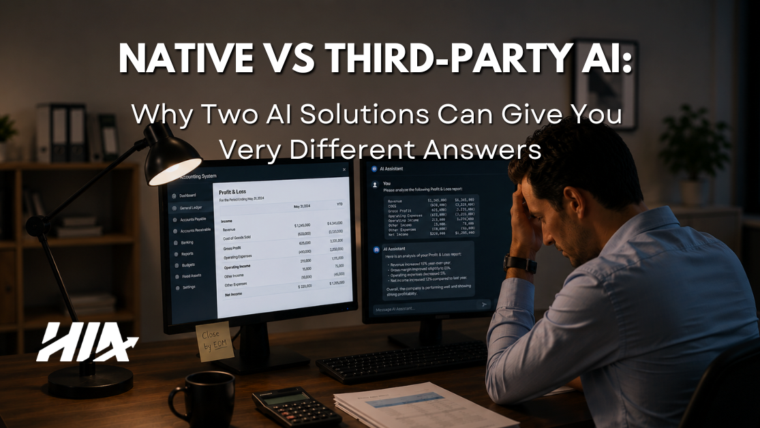
Native vs Third-Party AI: Why Two AI Solutions Can Give You Very Different Answers

Hotel finance teams are living with two forms of third-party AI — one from their vendor, one they built themselves — and both fail for the same underlying reason.

There’s a pattern playing out in hotel accounting departments right now. A controller finishes the monthly close, exports the P&L to a spreadsheet, and uploads it to ChatGPT or Claude. They type something like “explain the variances in this report” and get back a surprisingly readable narrative in thirty seconds. 

It feels like AI. It is AI. But it’s third-party, external AI that has never seen a USALI chart of accounts, doesn’t know what GOPPAR means, and has no idea that February’s labor numbers look off because of a shift scheduling change your GM made in week two. The output is fast. The question is whether it’s trustworthy—and whether “fast and untrustworthy” is actually an improvement over “slow and right.” 

This is the version of bolt-on AI that nobody talks about, because it isn’t a vendor’s decision. It’s a workaround finance teams built themselves. It illustrates the core problems with non-native, non-hospitality AI well – and these issues can be found in both export and upload scenarios and vendor solutions.

The Problem with the “Upload to AI” Workflow

The instinct behind exporting data and uploading it to AI for analysis is completely sound. Finance teams are busy, reports take time to interpret, and these tools are genuinely capable of producing readable analysis quickly. The problem isn’t that anyone is doing something wrong. The problem is structural.

When a controller uploads a CSV to ChatGPT or pulls a report into Claude, three things happen that limit how useful the output can actually be.

    1. The data is already stale. When using an add-on AI solution, whether that is an export-import scenario, or a 3rd party reporting tool, it is analyzing a moment frozen in time from the export, not the live financial state. 
    2. Sensitive financial data has left your system. Are proper security controls in place to protect your data and your business? Is the AI learning or training on your data?
    3. The AI has no context for what it’s reading. It sees a spreadsheet with department codes, line items, and variance figures. It doesn’t know that a rooms labor variance and an F&B labor variance aren’t comparable as percentages of revenue because the benchmarks are completely different. It doesn’t know that your February ADR number looks soft because of a group mix shift, not a rate problem. Third-party AI doesn’t know your market, your seasonality, your ownership’s reporting preferences, or what variances actually matter versus which ones are expected.

When it comes to hotel performance and financial reporting, someone still needs to stand behind these numbers in an owner meeting. And the finance leader presenting an AI-generated variance commentary they can’t fully verify is in a worse position than the one who wrote it themselves.

Why Bolt-On AI Can Only See Part of the Picture 

The third-party DIY export workflow is one version of bolt-on AI. The more consequential version — because it shapes a longer-term technology decision — can show up in vendor software.

Consider a general business accounting software or ERP offering an AI layer, it may have an AI chat which can answer questions about your data. The question is what the AI is actually reading from.

When AI is a layer on top of a generic accounting foundation, it inherits that foundation’s limitations. A general-purpose ERP wasn’t designed to be hospitality specific and understand USALI department structures. It doesn’t natively understand the relationship between GOPPAR and RevPAR, or why labor as a percentage of revenue means something different in rooms versus F&B, or how to read intercompany hotel transactions across a portfolio. The AI layer can be trained to recognize some of these concepts at the surface level — to produce output that uses the right terminology. But terminology isn’t context. And context is what determines whether the output is actually useful to a hotel finance team.

Take something as simple as vendor coding. One property might record a vendor as “ABC,” while another uses its full legal name, “A Better Company.” A hospitality finance leader spots this instantly. The general-purpose AI, reading from a system that doesn’t enforce a global vendor structure, may read them as two different vendors — and at the portfolio level, that means fragmented spend reporting, inaccurate vendor totals, and a duplicate payment risk that surfaces in an audit rather than at entry.

AI can’t improve the quality of the data it’s given. It can only interpret it. If the underlying information is fragmented, then the insight might require additional validation before anyone can act on it. 

That’s the gap: not whether AI can process the data, but whether it has the framework to interpret it correctly. 

Why Native, Hospitality AI Delivers More Clarity

Now imagine AI with direct access to your global chart of accounts, standardized vendor records, and hospitality-specific financial data that your team uses every day. The AI wouldn’t have to guess based on probabilities because it would have the exact context it needs to deliver certain, traceable answers. When AI is engineered into the system of record, it has insight into the entire accounting operations workflow. 

Instead of waiting for a report to see whether a GM made updates to an invoice or changes to a room expense, a native AI assistant within your financial ERP, can query your data in real-time to get that information. Anomaly detection can catch a duplicate invoice before it enters the approval workflow – not after it’s been paid and shows up in a reconciliation. Onboarding can reconcile property data with corporate ledgers automatically, accelerating PMS mapping. 

And because the AI is already living and working inside a single source of truth, you can build custom AI agents that answer questions using your own financial and operational information, with your security framework and your permission structure, without risking data leaks or requiring custom code.

That’s the real power of having an AI that’s built directly into your ERP & accounting system from the very start. It stops being a separate tool you have to manage and starts acting as an extension of your finance team.

The Future Includes Hospitality AI 

As AI becomes more embedded into hotel operations, hoteliers will start expecting more tailored capabilities. They’re going to want AI that understands the nuances that go into all areas of hospitality.

It’s one thing for AI to identify that labor costs increased or revenue declined. It’s another to actually speak hospitality. To know everyday hotel financial concepts like USALI, RevPAR, GOPPAR, market segmentation, etc., and the relationships behind them. To know how to analyze whether changes were driven by occupancy, seasonality, group business, market conditions, or operational decisions. It’s what finance teams evaluate every day, and it’s what leaders are going to expect their AI to understand. 

That’s where hospitality-native AI delivers real value. Not because it replaces finance teams, but because it supports them with insights that are more aligned with how hotels actually operate and report results. Because at the end of the day, someone still has to own the numbers. The right software foundation is what makes it possible to trust the AI that’s helping you get there.

To learn more about HIA’s native-AI capabilities in the ERP & accounting system finance teams rely on every day, schedule a demo.

Jaime Goss
Jaime Goss

Jaime Goss has over a decade of marketing experience in the hospitality industry. At Hotel Investor Apps, Jaime heads up marketing initiatives including brand strategy, website design, content, email marketing, advertising and press relations.

« More AI, More Control: What Hotel GMs Should Expect From Automation

Recent Posts

More AI, More Control: What Hotel GM's Should Expect From Automation

More AI, More Control: What Hotel GMs Should Expect From Automation

July 14, 2026
Unlock the Strategic Potential of your GM Critique

Beyond Month-End: Unlocking The Strategic Potential Of Your GM Critique

July 1, 2026

In The News

HIA Promotes Two Senior Leaders, Launches Dedicated Customer Success Department

July 2, 2026
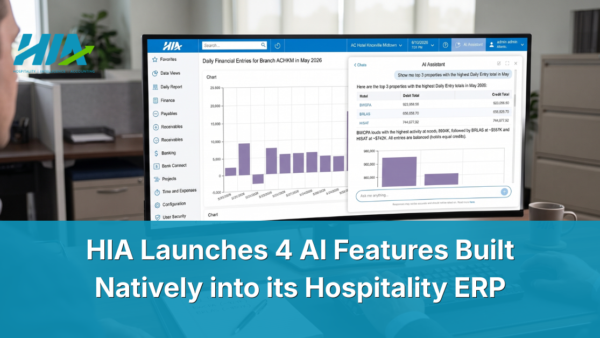
HIA Launches 4 AI Features Built Natively into its Hospitality ERP

HIA Launches 4 AI Features Built Natively into its Hospitality ERP

June 17, 2026

Case Studies

Rainmaker Hospitality Builds a Foundation for the Future with HIA ERP & Accounting Software

Rainmaker Hospitality Builds a Foundation for the Future with HIA ERP & Accounting Software

May 4, 2026
Platform Business Advisors scales smarter with HIA Hospitality ERP

Platform Business Advisors Scales Smarter with HIA Hospitality ERP

March 26, 2026

Downloads

Recover Up to 75 Hours Per Hotel Per Month

Recover Up To 75 Hours Per Hotel, Per Month

December 15, 2025
US Lodging Industry Update: The End of the Doldrums? Outlook for 2026 by R. Mark Woodworth

Outlook for 2026 – The End of the Doldrums?

October 22, 2025

Recent Videos

3 Best Practices For a Success Hotel Accounting Software Implementation

3 Best Practices for Hotel Accounting Software Implementation

June 23, 2026

1-Minute HIA Overview

June 23, 2026
HIA - Hospitality Intelligence Acconuting Logo HIA, A Product Of © Hotel Investor Apps Inc.
All rights reserved.

  • Website Terms Of Use
  • Privacy Policy
  • Application Privacy Policy
  • Contact Us
Award
2025 Travel and Hospitality Top Hotel ERP Solution
Award
2025 Acumatica Excellence Award Vertical Innovation
Award
2026 Acumatica Excellence Award Vertical Innovation
Award
2026 HTR Finalist Best Hotel Accounting Software
Award
Level 1 Certfied Customer Support
10 Years
10 Years of Empowering Hotel Management Excellence