

HIA Image
Press Release: HIA Launches 4 AI Features Built Natively into its Hospitality ERP
Hotel ERP and Accounting Software Logo Hotel ERP and Accounting Software Logo
  • Home
  • Platform
      Hospitality Accounting & Operations
    • AI-Powered Platform
      Backoffice Automations

    • Hotel ERP Platform
      Ops & Accounting Clarity

    • Integrations
      60+ Hospitality Specific
    • Features & Capabilities
      Built for Hotels

    • Halo GSS
      Rep Mgmt, Comp Sets, Rate Intel

    • Business Intelligence
      Your Whole Hospitality Timeline

    • Mobile App
      Your Backoffice in Your Pocket

  • Features By Role
    • For Finance Teams
    • For Operations
    • For Executives
    • For Owners
  • About Us
    • Executive Team
    • Acumatica
    • Awards
    • Board of Directors
    • Support
    • Careers
    • Contact Us
  • Resources
    • Blog
    • In The News
    • Customer Stories
    • Guides & Downloads
    • Videos
Request A Demo

The Growth Tax on Hotel Finance Teams

October 1, 2026
By Charlie Fritsch, CEO
  • Accounting software
  • Hotel ERP
The Growth Tax on Hotel Finance Teams

When your ERP or accounting system doesn’t speak hospitality every new contract, owner, and brand adds more work for your finance team.

Today, hotel management companies are coming to the table with more sophisticated requirements than they were even a few years ago. I see it in the RFPs we’re receiving. They’re longer, more specific, and much clearer about what finance teams expect their technology to handle.

Many of these teams have spent years stretching systems, building workarounds, and explaining hotel accounting to vendors point by point. And somewhere along the way, they noticed a pattern: every new property made the job harder. Every management contract brought another PMS to map, another set of entities to maintain, another owner package to build. The portfolio grew, and the finance team’s workload grew right along with it. 

That’s the growth tax: the extra work a finance team absorbs every time the portfolio expands on a platform that doesn’t understand hotels. 

An Integration List Only Tells You So Much

It’s important to consider that upgrading your hospitality back office isn’t as simple as moving the books from one accounting system to another. Most management companies today have an entire ecosystem feeding the books: PMS, POS, payroll, AP automation, banking, and often a BI layer in between.

Integrating with those systems is one thing. Knowing what to do with the financial data when it arrives is another. That’s where the distinction between “supports hospitality” and “built for hospitality” starts to matter.

A general accounting or ERP platform may be flexible enough to accommodate PMS and POS data, often routed through a third-party BI tool first. But in that setup, the hotel-specific translation happens outside the ledger, and your system of record isn’t where the hotel logic lives. Flexibility isn’t the same as understanding how hotel accounting works. 

The solution needs to know how POS revenue should be mapped by department, revenue category, tax bucket, and tender type. How payroll expenses coming from your payroll provider distributes to the GL. How invoices coded through AP automation still move through approval and payment, and how bank activity flows back for reconciliation.

If that understanding isn’t already built in, the hotel management company has to define how the data should move, where it should land, and what accounting activity it should trigger.

One Portfolio Can Mean Multiple Financial Relationships

Now take those complex integration workflows and factor in multiple properties, ownership entities, brands, and USALI. That creates an accounting structure you don’t encounter in most businesses.

It’s easy for anyone outside the industry to assume that a 50-property hotel management company operates like a multi-location business. But financially, that’s not how we operate. One portfolio usually represents dozens of separate financial entities underneath it. There are property and ownership books to maintain alongside the management company’s own corporate books. And financial activity doesn’t always stay neatly within those boundaries. Management fees move between the management company and the properties. Shared expenses may have to be allocated across hotels. Intercompany activity has to be reflected on both sides.

Then there are scenarios that controllers deal with regularly that might sound oddly specific to anyone outside the industry. For example, a regional employee’s payroll and benefits may need to be distributed across several hotels. Or one property may incur a cost on behalf of another. And corporate finance needs visibility across every entity while property teams only see their own.

General purpose ERPs or accounting systems handle multi-entity accounting well in the abstract. What they don’t come with is the hotel version of it: preserving entity boundaries while accounting for everything that crosses them, then producing owner reporting in the hotel-specific structure and standards those owners expect.

Hospitality Accounting Has Its Own Language

Most accounting platforms speak accounting really well. Where things get more complicated is when you ask them to speak hotel.

USALI. Night audit posting. Departmental operating schedules. AR city ledger. These aren’t separate accounting features; they’re hotel-specific terms that shape how financial activity moves through the books.

A general accounting platform may be perfectly capable of recording the journal entry at the end of the night. But does it know what should happen when the night auditor rolls the day? Where should PMS revenue land? 

Get the logic wrong and the consequences don’t stop at the GL. They carry through to departmental reporting and, ultimately, the financial reporting delivered to ownership.

“Capable” software offloads the real lift

A general purpose ERP is capable of many things. But in hotel finance, “can it do it?” is rarely the right question. Almost any modern ERP can be configured to do almost anything. The better question is who bears the brunt of making it work for hotels. 

In a non-hospitality ERP, someone has to design the hospitality layer: the USALI chart of accounts and departmental schedules, night audit posting rules, POS mapping, payroll distributions, management fees, intercompany entries, owner packages. That work usually falls to an implementation partner, third-party connectors, and your own team. Once it’s built, it’s extra cost and work to maintain and rework every time something changes. 

In a management company, something is always changing. A new contract brings a different PMS. An owner wants a different package format. A property converts brands. In a general ERP, each of those is a configuration project. In a hospitality-specific ERP, they’re scenarios the platform was built around.

The real difference isn’t what each system can eventually be made to do. It’s how much of the hotel logic your finance team has to own. And because that ownership grows with every property you add, that’s the growth tax.

AI Makes the Accounting Foundation More Important, Not Less

There’s an assumption that AI will eventually make some of this complexity easier to manage. We’re already asking it to capture and code invoices, learn vendor-level GL patterns, flag duplicate invoices and unusual transactions, and answer plain-English questions against live financial data. And that’s just the start. Finance teams want to use it to get even more financial insights like variance analysis and portfolio performance.

But there’s a catch: AI doesn’t make any of the complexity we’ve talked about disappear. It inherits it.

It inherits the integrations. The entity relationships. The departmental structure. The hotel-specific accounting logic. And the more sophisticated the task, the more of those relationships it needs to understand.  In a general ERP, much of that context lives in custom fields, partner-built scripts, and outside BI tools, places the platform’s own AI (if it exists), was never designed to look. 

If the underlying data is fragmented across systems or stripped of its hotel-specific context, adding another AI layer doesn’t suddenly put the financial picture back together.

That’s where having a single source of truth becomes such an advantage. Instead of asking AI to piece together the financial picture from disconnected systems, you’re giving it a unified system where that context already exists. 

And that hospitality-specific foundation doesn’t just matter for AI. It’s what eliminates the growth tax. With HIA’s hospitality-specific accounting and ERP in place, we’ve seen hotel companies grow their portfolios by more than 50% without adding accounting staff.

In summary, full ERP functionality is increasingly needed by larger growing hotel portfolios, with added functionality such as a purchase order module, fixed asset module, project accounting and more. So while getting a complete ERP is more important today than ever for hotel companies, if that ERP was not built for hospitality, the hotel company will bare the brunt of the workarounds and pain points trying to make a round peg fit in a square hole. Alternatively the legacy hotel specific accounting platforms lack the full ERP functionality, lack modern automations and integrations, and so they fail to fulfill the needs of enterprise hotel companies, just as generic ERPs fail to provide the hospitality specific context. HIA provides the only complete back office ERP built for hospitality that delivers the latest technology with more automations and better data integrations.

If your finance team’s workload still grows with every property you add, we’d be happy to show you what a hospitality-specific approach looks like.

Charlie Fritsch, Founder & CEO - HIA
Charlie Fritsch, CEO

Charlie Fritsch is CEO and Founder of Hotel Investor Apps, Inc., makers of HIA, the ERP purpose-built for hospitality. With over 30 years of hotel brokerage and commercial real-estate and capital funding experience, Charlie created HIA with the express intent of simplifying and elevating hospitality financial management. Charlie is committed to always expanding HIA’s capabilities to further consolidate and streamline hospitality back-office functionality.

« Why Hotel Management Companies Fall Behind on AR — And How to Fix It

Recent Posts

Why Hotel Management Companies Fall Behind on AR — And How to Fix It

September 15, 2026
The Hotel Back Office Is Becoming Real-Time

The Hotel Back Office Is Becoming Real-Time: Two Operators Prove It’s Already Happening

September 1, 2026

In The News

HIA Promotes Two Senior Leaders, Launches Dedicated Customer Success Department

July 2, 2026
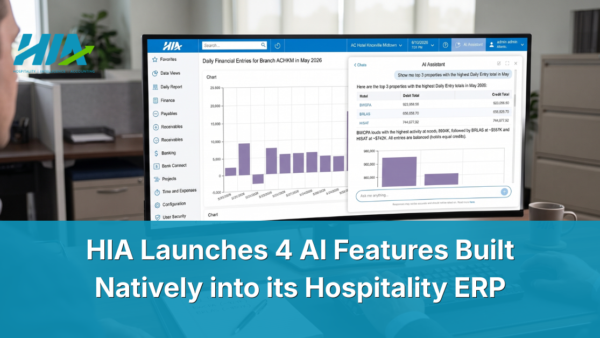
HIA Launches 4 AI Features Built Natively into its Hospitality ERP

HIA Launches 4 AI Features Built Natively into its Hospitality ERP

June 17, 2026

Case Studies

How Lowen Hospitality Management Positioned Itself for Growth with HIA ERP

August 31, 2026
Rainmaker Hospitality Builds a Foundation for the Future with HIA ERP & Accounting Software

Rainmaker Hospitality Builds a Foundation for the Future with HIA ERP & Accounting Software

May 4, 2026

Downloads

Recover Up to 75 Hours Per Hotel Per Month

Recover Up To 75 Hours Per Hotel, Per Month

December 15, 2025
US Lodging Industry Update: The End of the Doldrums? Outlook for 2026 by R. Mark Woodworth

Outlook for 2026 – The End of the Doldrums?

October 22, 2025

Recent Videos

3 Best Practices For a Success Hotel Accounting Software Implementation

3 Best Practices for Hotel Accounting Software Implementation

June 23, 2026

1-Minute HIA Overview

June 23, 2026
Hotel night audit packet with daily revenue cards, PMS folio, reconciliation check, and finance ledger.

Hotel Night Audit: What Operators Need After The Daily Close

August 31, 2026
Hospitality software source-of-truth binder with PMS card, finance ledger, approval seal, BI folio, and owner reporting packet.

Hospitality Software: What Hotel Operators Need Beyond Point Tools

August 27, 2026
Hotel asset management portfolio review folio with property tabs, owner packet, financial ledger, and performance cards.

Hotel Asset Management: What Owners Need Before Portfolio Review

August 26, 2026
Financial reporting software owner-review packet beside a governed hotel ERP ledger, budget cards, and property tabs.

Financial Reporting Software for Hotels: What Operators Need Before Owner Review

August 25, 2026
HIA - Hospitality Intelligence Acconuting Logo HIA, A Product Of © Hotel Investor Apps Inc.
All rights reserved.

  • Website Terms Of Use
  • Privacy Policy
  • Application Privacy Policy
  • Contact Us
Award
2025 Travel and Hospitality Top Hotel ERP Solution
Award
2025 Acumatica Excellence Award Vertical Innovation
Award
2026 Acumatica Excellence Award Vertical Innovation
Award
2026 HTR Finalist Best Hotel Accounting Software
Award
Level 1 Certfied Customer Support
10 Years
10 Years of Empowering Hotel Management Excellence