

HIA Image
Press Release: HIA Named Top 3 Hotel Accounting Software 2026!
Hotel ERP and Accounting Software Logo Hotel ERP and Accounting Software Logo
  • Home
  • Platform
    • Hotel ERP Platform
    • Hotel Integrations
  • Features By Role
    • For Finance Teams
    • For Operations
    • For Executives
    • For Owners
  • About Us
    • Executive Team
    • Acumatica
    • Awards
    • Board of Directors
    • Support
    • Careers
    • Contact Us
  • Resources
    • Blog
    • In The News
    • Customer Stories
    • Guides & Downloads
    • Videos
Request A Demo

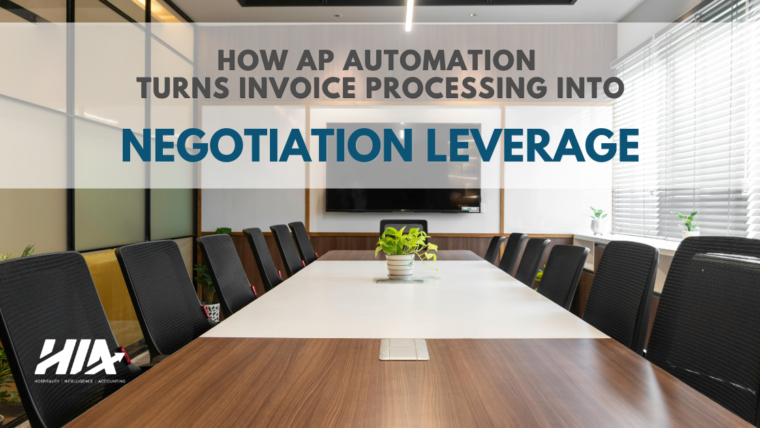
How AP Automation Turns Invoice Processing Into Negotiation Leverage

May 7, 2026
By Elisa Fritsch
  • Accounting software
How AP Automation Turns Invoice Processing Into Negotiation Leverage

Cost control is top of mind for most hotel finance teams at the moment. Controllers might suspect that they might be overpaying somewhere, but if something really was off, they’d be able to see it, right?

That was exactly the thinking of one VP of Finance who managed a 75-property hotel group. Because workflows were running as expected, they assumed everything was fine. It wasn’t until they reviewed a vendor spend across the entire portfolio that a discrepancy came into view. 

For months, one property was paying $6,500 a month, while another comparable property was paying almost half that for the same items from the same vendor. This discovery raised some questions. Why were the rates so different? Wasn’t there a unified contract in place? And how many other locations were paying something completely different? As it turns out, 25 of their properties were operating under different contracts with that same vendor, and leadership wondered how this could fly under the radar for so long.

Scenarios like this happen more often than they should for multi-location organizations, but why?

Key Takeaways
  • Property-level workflows limit portfolio-level insight. 
  • Manual invoice processing is still the norm, and they slow everything down.
  • Centralized AP automation turns raw invoice data into something teams can actually analyze.  

Why No One Sees the Cross-Portfolio View 

More often than not, the AP processes teams use are designed to work at the property level. Invoices come in, get manually coded to the appropriate GL, routed for approval, and tied back to a single location’s P&L while the paper copy or PDF gets stored in a filing cabinet in-house. 

From an operational standpoint, it makes complete sense. Every property is responsible for its own performance. The workflows they implemented support that. 

But when all the data is kept in isolation like this, it creates subtle gaps in visibility that make it harder to identify spend issues because no one is looking across the full set of properties at once. 

  • Regional Managers review their own property’s numbers and budget variances.  
  • AP Teams process what comes in, focusing on accuracy and payment deadlines rather than price benchmarking.  
  • Procurement may negotiate the contracts, but they rarely have the visibility to verify if those terms are actually being honored on every invoice, at every location, every month.

Everyone is doing their job. But no one is positioned to see the full picture. The information needed to compare vendor pricing, identify outliers, or verify contract terms is already in their systems. But without an easy way to access the data, it remains essentially invisible. 

Turning AP Data Into Something You Can Use 

Hotel accounting teams are processing thousands of invoices per month. What slows them down isn’t just volume. It’s the messiness inside the volume. 

Vendors don’t tend to send clean, consistent documents that are formatted to your existing structures. They send multi-page PDFs, combined statements, revised invoices, and formats that change without warning. Teams are left manually splitting those documents across properties and coding them individually. 

When AP data is processed this way, small differences are easy to overlook. Trying to find those differences ends up becoming a massive drain on time that teams simply don’t have.  

AP Automation Changes the Game

What once took hours can be done in minutes with AP automation. When invoices flow through a centralized platform (like Factura), they can be: 

  • Split across locations 
  • Coded consistently at the line-item level based on rules that are set
  • Stored in a unified system 
  • Queried by vendor, location, and time period
  • Flagged for discrepancies that require manual review

Because the system that processes the invoices is the same system that stores and structures the data, teams don’t need to move it into a separate BI tool just to answer basic questions about vendor spend. The visibility is built into the workflow itself. It shifts AP from a record of what happened into a system that shows you what’s actually going on. 

AI Invoice Recognition Simplifies Processes

That VP of Finance we mentioned earlier saw this firsthand when they started using AP automation. One of their vendors sent in a 100-page PDF that contained dozens of invoices bundled together. Instead of waiting for someone to manually break it apart, the system used AI to separate and structure the entire file in minutes. Each invoice was tied to the correct property, vendor, and GL code based on existing rules as it moved through the workflow. 

By the time the AP team got their hands on it, they were able to do a quick review and make decisions almost immediately. The backlogs stopped, and the way the team interacted with AP started to change. It wasn’t just about getting invoices processed anymore. It was about getting clearer visibility into what they were actually paying and why.  

How Visibility Changes Vendor Conversations 

Vendors always know exactly how much you’re spending with them. Once your data is centralized and structured, you do too. That level of visibility makes it possible to see what was previously buried in invoice-level detail. Things like: 

  • Legacy pricing that was never updated 
  • Rate increases that only hit certain properties 
  • Spend volume that makes renegotiation viable

And that changes the dynamic. 

Instead of walking into a negotiation with scattered examples, a couple of invoices that don’t look right, or feedback from individual properties, procurement teams can show up with a consolidated, portfolio-wide view of spend. Conversations quickly change from “Can you explain this charge?” to “Here’s exactly where it is and how often it’s happening.”

It’s a subtle shift, but a powerful one. You’re no longer just another customer asking questions. You’re a portfolio with a clear, defensible understanding of your numbers, and that’s the difference between noticing an issue and being able to do something about it. 

The Bigger Opportunity Most Teams Miss 

Operators taking full advantage of AP automation, like Platform Business Advisors, aren’t just doing it for increased efficiency. They’ve realized that every invoice flowing through the system is creating one of the clearest streams of truth they have. Not just for hotel accounting, but for understanding vendor performance, pricing consistency, and where money is quietly slipping through the cracks. 

Efficiency may be the baseline, but the spend intelligence provided by AP automation becomes a competitive advantage, especially in a market where margins are razor-thin.

If you’ve never looked at your cross-portfolio spend by vendor or haven’t done it in a while because it would require a day of building spreadsheets, then let our experts show you how easy it could be to see what your data is trying to tell you. 

Elisa Fritsch
Elisa Fritsch

VP of Communications at HIA

Elisa Fritsch, VP of Communications at Hotel Investor Apps (HIA), contributes 15+ years of sales and marketing experience from a wide range of corporate to start-up environments. At HIA, Elisa focuses on marketing strategy, content, and leveraging her hospitality industry knowledge to drive growth.

« Fresh Features: HIA’s Q1 2026 Software Enhancements

Recent Posts

Fresh Features: HIA’s Q1 2026 Software Enhancements

April 30, 2026
Labor Is Your Biggest Cost Line. Here’s How to Actually See It.

Labor Is Your Biggest Cost Line: Here’s How To Actually See It

April 15, 2026

In The News

Hospitality Net: AI in Hotel Accounting - Separating Table Stakes from the Next Wave

AI in Hotel Accounting: Separating Table Stakes from the Next Wave

April 15, 2026
Hotel Management: How AI Can Change the Hotel Back Office

Assist. Automate. Elevate. The AI Transformation of Hospitality’s Back Office Is Underway

April 1, 2026

Case Studies

Rainmaker Hospitality Builds a Foundation for the Future with HIA ERP & Accounting Software

Rainmaker Hospitality Builds a Foundation for the Future with HIA ERP & Accounting Software

May 4, 2026
Platform Business Advisors scales smarter with HIA Hospitality ERP

Platform Business Advisors Scales Smarter with HIA Hospitality ERP

March 26, 2026

Downloads

Recover Up to 75 Hours Per Hotel Per Month

Recover Up To 75 Hours Per Hotel, Per Month

December 15, 2025
US Lodging Industry Update: The End of the Doldrums? Outlook for 2026 by R. Mark Woodworth

Outlook for 2026 – The End of the Doldrums?

October 22, 2025

Recent Videos

GOP Flex and Flow-Through Dashboard

New Feature – GOP Flex and Flow-Through Dashboard

April 2, 2026

8 Ways To Use AI In Hotel Accounting

May 27, 2025
HIA - Hospitality Intelligence Acconuting Logo HIA, A Product Of © Hotel Investor Apps Inc.
All rights reserved.

  • Website Terms Of Use
  • Privacy Policy
  • Application Privacy Policy
  • Contact Us
Award
2025 Travel and Hospitality Top Hotel ERP Solution
Award
2025 Acumatica Excellence Award Vertical Innovation
Award
2026 Acumatica Excellence Award Vertical Innovation
Award
2026 HTR Finalist Best Hotel Accounting Software
Award
Level 1 Certfied Customer Support
10 Years
10 Years of Empowering Hotel Management Excellence