

HIA Image
Press Release: HIA Named Top 3 Hotel Accounting Software 2026!
Hotel ERP and Accounting Software Logo Hotel ERP and Accounting Software Logo
  • Home
  • Platform
    • Hotel ERP Platform
    • Hotel Integrations
  • Features By Role
    • For Finance Teams
    • For Operations
    • For Executives
    • For Owners
  • About Us
    • Executive Team
    • Acumatica
    • Awards
    • Board of Directors
    • Support
    • Careers
    • Contact Us
  • Resources
    • Blog
    • In The News
    • Customer Stories
    • Guides & Downloads
    • Videos
Request A Demo

Industry Outlook For 2026: The End Of The Doldrums?

January 7, 2026
By R. Mark Woodworth
  • News Headlines
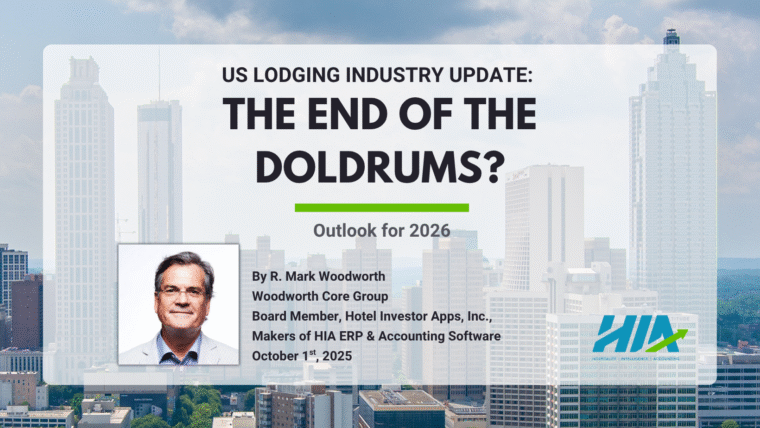
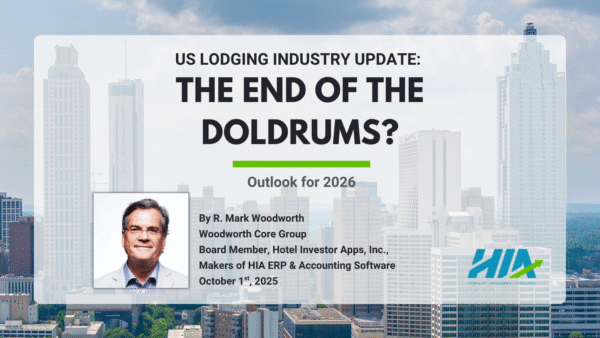
US Lodging Industry Update: The End of the Doldrums? Outlook for 2026 by R. Mark Woodworth

By R. Mark Woodworth, Principal, Woodworth Core Group

Mark Woodworth, Board of Directors - HIA

Mark Woodworth, Principal of Woodworth Core Group and Board Member of Hotel Investor Apps Inc., brings over 40 years of hospitality industry advisory experience, including at CBRE Hotels and PKF Consulting, to inform his perspective on the current economic outlook for the U.S. lodging industry.

For much of 2025, the U.S. hospitality industry has been caught in the doldrums, defined by a ‘wait and see’ approach amidst significant macroeconomic headwinds. But on the horizon, the forecast is clearing.

“The doldrums are a band of low-pressure and light winds near the equator…. Early sailors named it the doldrums due to getting stuck in these windless areas, and the term now refers to any period of stagnation or inactivity.”

The definition above seems to aptly capture the recent state of the transaction side of the U.S. lodging industry…. “A period of stagnation or inactivity.” Because market values continue to lag replacement costs in the vast majority of markets for most property types, new development levels remain depressed. Weak industry fundamentals (as year-over-year demand levels have remained flat or declined in six of the last nine quarters, causing real average daily rate levels to decline consistently since Q2 2023), according to CoStar.

The U.S. hospitality industry stands at a critical juncture as it approaches the end of 2025, shaped by an array of macroeconomic challenges and shifting fundamentals. At the September 2025 HAMA Fall Conference, I had the opportunity to share my outlook for hotel performance in the year ahead, including cap rates and investment strategy, drawing on data and forecasts from CBRE, CoStar, Moody’s, the Federal Reserve, and other industry benchmarks. [1] The following are key indicators shaping my outlook.

Navigating Cap Rate Trends and Market Fundamentals

Understanding the trajectory of hotel cap rates requires a careful look at both historical and current market drivers. The average hotel cap rate for 2025 year-to-date stands at 9.5%, according to CoStar, signaling a marked increase from prior cycles. With the 10-year U.S. Treasury yield hovering at 4.25% and the Federal Funds Rate projected to decline over the next two years from 4.31% at year-end 2025 to 4.15% by year-end 2027, will the risk premium required by hotel investors begin to show signs of moderation?

While expectations suggest interest rate cuts of +/-75 basis points over the next year, research conducted by Jack Corgel of Cordial Hotel Property Research and Senior Advisor to our firm, Woodworth Core Group, reveals that hotel cap rates are largely insensitive to changes in the 10-year treasury rate.

For example, assuming a 3.0 percent 10-year rate, an 8.0 percent hotel cap rate, and an elasticity of .07 (the historic average), a 10% change in the 10-year to 2.7 percent should result in a hotel cap rate of 7.9 percent (rounded).

In summary, while the expected interest rate cuts will likely sway hotel cap rates downward, the decline in the near to mid-term will be modest at best. The slight reduction in the overall cost of capital will only partially offset the impact of persistently high construction costs and inflationary pressures, suggesting that domestic development activity will remain stagnant in 2026.

Key Economic Indicators: Unemployment, Uncertainty, and Lending Standards

Despite a broad recovery in 2024, the U.S. economy is clearly in a period of weaker growth, with real gross domestic product (GDP) expansion slowing from 2.80% in 2024 to a projected 1.03% in 2025, according to the Wall Street Journal consensus forecasts. Inflation is expected to moderate throughout 2026, falling from 3.58% at year-end 2025 to 2.61% by the end of 2026. Meanwhile, the nationwide unemployment rate is projected to rise slightly, peaking at 4.69% by late 2025 and remaining near 4.6% through the following year.

Uncertainty remains a signature feature of the current cycle, shaped by trade wars, heightened tariff rates, and public policy debates. For example, effective U.S. tariff rates surged in early 2025, with major trade partners including China and the UK experiencing adjustments that elevated import duties. Moody’s Analytics identifies the leisure and hospitality sector as the most exposed to these geopolitical currents.

Concurrently, both loan origination volumes and average CMBS loan sizes have decreased as lending standards tightened earlier in the year. However, more recent quarters have seen a modest loosening of standards for new development, which could set the stage for renewed growth if interest rates decline significantly.

Labor and Migration Restrictions

Operational challenges remain acute, especially in the area of workforce availability. Net U.S. migration is expected to decline to an estimated 1.6 million in 2025. The lodging industry is particularly reliant on non-citizen labor: according to the Bureau of Labor Statistics (BLS),16 percent of all employees and more than a third of housekeeping staff fall into this category. Restrictive immigration policies may tighten labor markets further and disproportionately affect hospitality operators in gateway and government-dependent markets.

Demand Outlook

On the demand side, based on data from Kalibri Labs, 2025 year-to-date U.S. lodging demand is down 1% through late July, with the government segment hit hardest (-11% compared to the previous year). Corporate transient demand has softened (-3%), while modest growth has been seen in OTA, loyalty, and discount segments. Notably, the industry is witnessing a significant shift as vacation rental supply growth far outpaces traditional hotel inventory growth, per AirDNA and STR data.

Profitability, Liquidity, and Volatility

Profitability has shown signs of strain, with Gross Operating Profit per Available Room (GOPPAR) declining 2.7% year-over-year in June 2025, as cost increases outstrip revenue gains, according to CBRE. CBRE also notes liquidity is “returning to normal,” but expects volatility to remain above pre-pandemic norms in the near- to mid-term. Lending standards—cited from the Federal Reserve’s Senior Loan Officer Opinion Survey—have alternated between tightening and loosening, reflecting ongoing caution among lenders.

Outlook for 2026 and Beyond: Clouds Dissipating

Looking forward, the narrative is cautiously optimistic, and the doldrums will fade into history. “Wait and see” will characterize the remainder of 2025, but 2026 is positioned as a turnaround year, with Oxford Economics projecting stronger GDP growth, moderating inflation, and the return of group and international travel. Supply growth will lag demand through the end of the decade, supporting profit gains for existing hotels—even as new project feasibility remains challenged by high costs and lingering uncertainty.

By 2027, industry sentiment expects some of the strongest lodging performance in decades. Meanwhile, hotel cap rates are expected to trend downward, returning to 2019 levels by 2026 or 2027 as market risk premium fades and capital availability recovers.

References: All figures and outlooks are based on data, charts, and research quotes from the HAMA Fall 2025 Conference presentation (R. Mark Woodworth / WoodworthCore.com), utilizing sources including Cordial Hotel Property Research, Kalibri Labs, CBRE Hotels Research, CoStar, Moody’s Analytics, Oxford Economics, STR, AirDNA, and BLS.

« HIA Announces Promotion of Chris Hall to Chief Revenue Officer HIA Named Top 3 Hotel Accounting Software in 2026 Hotel Tech Awards! »

Recent Posts

2026 Will Reward the Prepared: Are Your Financials Deal-Ready?

2026 Will Reward the Prepared: Are Your Financials Deal-Ready?

March 2, 2026
The End of Data Silos: How a Unified ERP Empowers Hospitality Management Companies

The End of Data Silos: How a Unified ERP Empowers Hospitality Management Companies

February 16, 2026

In The News

HIA Recognized for Innovation 4th Year Running by Acumatica ERP!

February 5, 2026
HIA, the Hospitality ERP, Named Top 3 Hotel Accounting Software in 2026

HIA Named Top 3 Hotel Accounting Software in 2026 Hotel Tech Awards!

January 21, 2026

Case Studies

Baywood Hotels Receives Actionable Insights with HIA’s ERP & Business Intelligence

July 15, 2025
Hotel Solutions Embraces ERP Technology

Hotel Solutions Embraces ERP Technology to Improve Processes & Client Satisfaction

April 15, 2025

Downloads

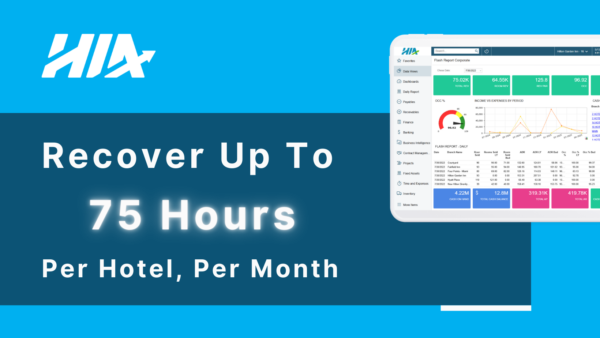
Recover Up to 75 Hours Per Hotel Per Month

Recover Up To 75 Hours Per Hotel, Per Month

December 15, 2025
US Lodging Industry Update: The End of the Doldrums? Outlook for 2026 by R. Mark Woodworth

Outlook for 2026 – The End of the Doldrums?

October 22, 2025

Recent Videos

8 Ways To Use AI In Hotel Accounting

May 27, 2025

Hotel Management Dashboards: What Can They Do For You?

May 27, 2025
HIA - Hospitality Intelligence Acconuting Logo HIA, A Product Of © Hotel Investor Apps Inc.
All rights reserved.

  • Website Terms Of Use
  • Privacy Policy
  • Application Privacy Policy
  • Contact Us
Award
2025 Travel and Hospitality Top Hotel ERP Solution
Award
2025 Acumatica Excellence Award Vertical Innovation
Award
2026 Acumatica Excellence Award Vertical Innovation
Award
2026 HTR Finalist Best Hotel Accounting Software
Award
Level 1 Certfied Customer Support
10 Years
10 Years of Empowering Hotel Management Excellence