
Over the past decade, hospitality tech stacks have exploded, with more apps and services promising better visibility and deeper insights to make reporting easier and let decisions happen faster. And in many ways, they delivered. Teams now have access to more data than ever before.
But as many hoteliers have had time to sit with these new tools, they’ve come to the subtle realization that more data does not equal more clarity. If anything, it’s making too much noise. Instead of unlocking critical insights needed for revenue and operational improvement, teams are literally drowning in data that lives in silos, forcing them to manually stitch it together just to make it usable.
Leaders have expressed this concern at nearly every conference we attended in 2025. In fact, it’s been reported that nearly half of hoteliers cite disconnected systems and limited access to data as the biggest barriers to making informed decisions.
They need a way to unify data that preserves quality, connects workflows, and gives leaders real-time visibility across their entire portfolio. A hospitality ERP is the solution they’ve been looking for.
The Silent Damage Data Silos Do to Daily Workflows
Perhaps the most dangerous problem with data silos is that they don’t cause obvious breakdowns. Systems stay operational. Reports still get delivered. Month-end closes still happen. On the surface, things appear to be working.
The real damage happens in the margins. The space between when information is generated and when it’s actually usable. When systems don’t speak to each other, it’s got to be combined somehow, and that almost always means manual workarounds and human involvement.
An export here. A spreadsheet there. Shadow reports are built to reconcile differences. Follow-up emails are sent to confirm the numbers, not because teams didn’t trust each other, but because the systems don’t tell the same story. None of this shows up on a balance sheet, but it quickly becomes a death by a thousand cuts on your team’s momentum and ability to make proactive decisions.
We’ve watched organizations build entire workarounds just to answer basic questions about performance. Not because the data wasn’t there, but because it couldn’t be trusted or accessed in one place, at the right time.
That’s why data silos are so costly. They don’t announce themselves as a crisis, but they slowly bleed efficiency and visibility until leadership is managing by hindsight instead of insight.
What Are the Data Silos That Are Currently Happening?
Data silos aren’t confined to one system or department. Most show up slowly. Every new update. New tool. New system online. Each one brings with it a wealth of data, but it’s limited to the system it’s in.
The most common places I see them show up are:
-
- Foundational (core back-office) systems: Where financial and operational data live separately, delaying insight and introducing manual reconciliation (e.g., PMS, POS, accounting, payroll, HR, procurement, accounts payable, business intelligence, etc.).
- On-property systems: Where day-to-day activity becomes disconnected from financial outcomes (e.g., front desk operations, food & beverage outlets, housekeeping, engineering and maintenance, on-property service workflows, etc.).
- Portfolio-level: Where inconsistent reporting makes side-by-side performance comparisons unreliable (e.g., property-level financial data, corporate and ownership reporting, charts of accounts, vendor and spend data, cross-property performance reporting, etc.).
Eliminating these silos requires more than better reporting or adding another tool to an already crowded tech stack. It requires a system designed to unify back-office operations, preserve data integrity, and connect information across the entire portfolio. That’s precisely what an ERP does.
What Changes When Data Is Unified Under a Hospitality ERP
While there are some differences between a generic ERP and a hospitality ERP, they are both built to unify back-office workflows and reduce the friction caused by disconnected systems.
Where hospitality-specific platforms differentiate is in how well they conform to the realities of hotel operations. When all your data flows through a system that actually speaks “hotel”, the impact on daily workflows and financial visibility is immediate. Here’s what that looks like in practice.
One Single Source of Truth
This is what we’ve seen teams asking for time and time again: one system where they can quickly see all financial and operational data, without manual stitching, rekeying, or reconciling just to answer basic questions. An ERP does this by capturing data once and making it usable everywhere.
As one hospitality operator put it after moving to HIA’s unified ERP platform:
“…it has truly become one of the most valuable tools in our back-office operations. From accounting and reporting to automation and integrations, HIA ties everything together in one centralized platform. Before HIA, managing data from multiple properties used to be time-consuming…there was always something slipping through the cracks.”
Real-Time Financial Health Snapshots Across Properties
Owners are putting more pressure on hotel management companies to deliver on-demand snapshots of their financial health. They want to know how their properties are performing now, not weeks after the window to make critical decisions has passed. Unfortunately, it’s not within the realm of possibilities for fragmented systems.
A leading midwest management company, RainMaker Hospitality, identified and addressed this challenge early-on as its portfolio grew. When accounting and operational data lived in separate systems, their visibility had suffered not because the data didn’t exist, but because it couldn’t be accessed together when it mattered most. An early adopter of HIA’s unified hospitality ERP, they were able to get ahead of the curve and empower their team and owners with faster, on-demand access to portfolio-wide financial insight.
You can read more about how RainMaker Hospitality made the switch to a unified platform here.
Live P&L Visibility with Integrated Daily Payroll Metrics
Labor is one of the largest and most volatile costs on a hotel’s P&L. Yet in many organizations, payroll data lives outside the financial accounting system, making it difficult to understand how daily staffing decisions impact profitability.
ERPs make it possible to work towards a live P&L that both reflects daily performance and connects labor spend to financial outcomes in real time. This allows operators to spot issues earlier, adjust staffing decisions, and protect margins before they erode.
That was a key focus for Lark, a leading boutique hotel management company, as they scaled their portfolio and sharpened their focus on NOI. By integrating daily payroll data directly into their financial reporting, Lark gained earlier visibility into labor trends and the ability to manage performance proactively, rather than reacting at month-end. That shift helped align operations and finance around shared goals and gave leadership clearer insight into how day-to-day decisions impacted overall performance.
To read more about Lark’s story moving to HIA’s ERP & Accounting system, explore the full case study, or listen to Scot Hopps discuss the transformation on the Hotel Tech Insider podcast.
Consistency Across Properties with Standardized, Comparable Reporting
Another large pain point for disconnected systems is the standardization of data. Even when every property is technically “reporting,” the lack of standardization means portfolio-level insights require explanation, adjustment, and manual reconciliation.
An ERP solves this problem at the foundation. By enforcing a global chart of accounts and consistent categorization across all properties, it guarantees that data is captured the same way everywhere.
Baywood Hotels, a nationwide ownership and management company with 130+ hotels, faced this exact challenge as its portfolio continued to expand across regions. Leadership wanted to better understand how properties were performing, not just in isolation, but side by side. The Vice President of Operations stated,
“The ability to standardize reports, track compliance, and compare property performance side by side has been a huge win for our region. It gives everyone—from GMs to corporate leadership—a clear picture of how each hotel is performing and where attention is needed. That level of transparency has made us more proactive and data-driven as an organization.”
To learn more about how Baywood uses ERP & Accounting technology to standardize reporting and business intelligence to inform portfolio-wide decisions, read their story.
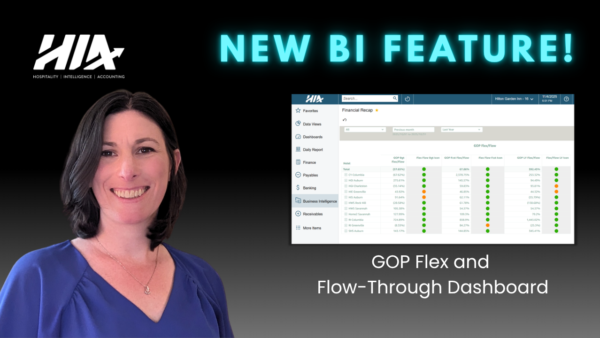
Holistic Performance Dashboards That Connect Operations to Financial Impact
When teams only see isolated metrics, the connection between daily work and financial outcomes gets lost. A hospitality ERP makes it possible to link operational activity directly to financial performance, giving teams context for why their work matters.
Holistic dashboards connect labor efficiency, productivity, and operational behavior to revenue and profitability. Instead of reviewing numbers in isolation, teams can see cause and effect in real time.
For Lark, this connection helped reinforce accountability across properties. As Scot Hopps, VP of Operations, noted:
“If there are dashboards they can see, it really helps connect them to why it matters how long it takes me to clean a room or convert a call.”
That visibility changed how their teams engaged with performance. Questions became more proactive. Decisions became more informed. And data became a tool for alignment, not a source of friction.
The Bigger Shift
Taken together, these changes to unify data represent more than operational efficiency. They reflect a shift in how hospitality organizations manage complexity at scale.
When data is unified, leaders stop managing around their systems and start managing through them. That’s the difference between reacting to reports and running the business with confidence.
If you’re curious what that kind of unified visibility could look like for your portfolio, see HIA’s unified hospitality ERP in action to clarify what’s possible. Reach out to our team today.

Co-founder and COO
Chip Fritsch, instrumental in overseeing HIA’s daily operations, brings 15+ years of hospitality industry experience to his role. His responsibilities span from product development to business growth strategies and client onboarding. A former full-service hotel General Manager, Chip knows the in-and-outs of hotel operations and that motivates him to develop new products and services to best support hoteliers. The past 7 years have seen Chip immersed in hospitality software where he has been pivotal in helping HIA win the Acumatica Development Award.